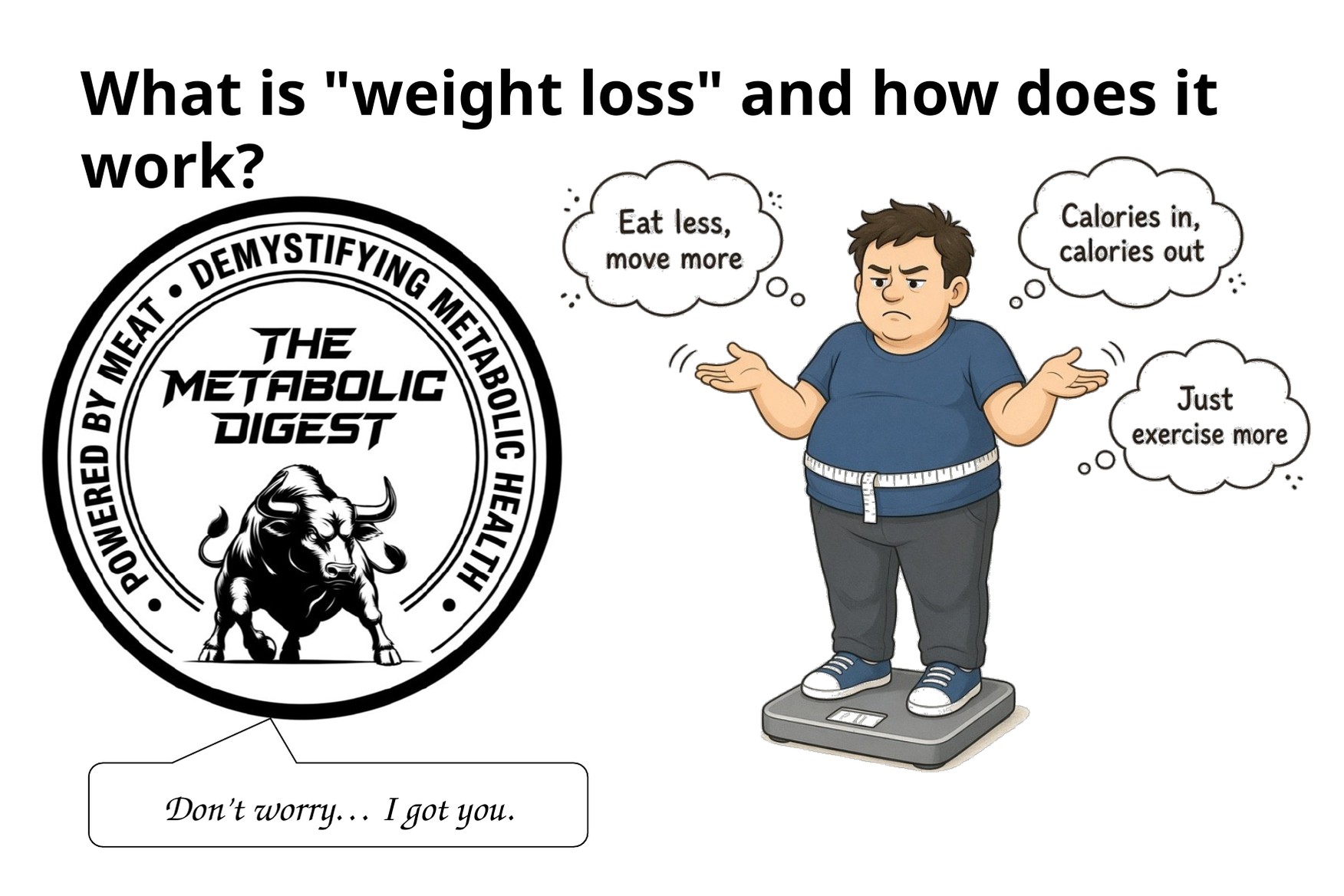
What is “weight loss” and how does it work?
These articles are for information only. They are not medical advice, diagnosis, or treatment. Read the full disclaimer.
Informational only — not medical advice.
Bottom line first
When people say “weight loss,” they almost always mean losing excess body fat. That process slows way down while insulin stays high. The practical path is keeping insulin in a normal range most of the day with a whole-food, low-carb, animal-based diet, then using fasting and movement to increase fat release while protecting muscle. The goal is better metabolic health, not a number on the scale.
What “weight loss” usually means
When you step on a scale, that measurement of your weight includes water, glycogen, muscle, bone, and fat. The change that matters for most people is reducing excess fat stores. Muscle loss is not the goal. Protecting it is. That is where weight loss ties back to metabolic health.
What we want is lipolysis. What does that mean?
Lipolysis is the breakdown of stored fat (triglycerides inside fat cells) into free fatty acids and glycerol so the body can use them for energy. Free fatty acids leave the fat cell and can be oxidized by muscle, heart, and other tissues to produce ATP, the energy cells use. The glycerol backbone that holds the triglyceride together can be converted into glucose. The liver can convert fatty acids into ketones, an efficient, usable form of energy.
Simple picture: the fat cell is a locked pantry. Lipolysis is opening the door and taking the stored fuel out. The body is adept at using multiple substrates to produce energy.
Insulin is the gatekeeper
Insulin’s main job is controlling substrate utilization and storage. When it is elevated, it tells fat cells to hold onto fat and tells the body not to release it. Lipolysis slows way down when insulin is high.
Insulin levels fall into three broad categories. These are plain-language categories, not clinical cutoffs. Where a medical term applies, it is named.
High insulin keeps fat locked in storage. The medical term is hyperinsulinemia. Over time, chronically high insulin is tied to insulin resistance, and lipolysis is suppressed.
Normal insulin is the standard state of a healthy person between meals. It allows a normal degree of lipolysis so the body can release and use fat stores.
Too little insulin usually means the body is not producing enough insulin on its own, as in untreated type 1 diabetes. The medical term is insulin deficiency. This is an uncontrolled fat-burning state that does not shut off without exogenous insulin. It is a medical condition, not the normal fasted state, and it is deadly if untreated.
Constantly elevated insulin — from frequent carbohydrate intake, especially refined carbohydrates — keeps the gate closed most of the day. Ben Bikman’s work makes the case that insulin is the primary regulator of fat storage and fat release. Normal insulin between meals is what allows meaningful lipolysis.
A whole-food, low-carbohydrate, animal-based pattern (meat, eggs, fish, dairy if tolerated, animal fats) keeps insulin in the normal range between meals. That is the baseline condition that allows lipolysis to occur. It is not a short-term trick. It is the eating pattern that allows the gate to cycle normally around fat burning.
Untreated type 1 diabetes shows this clearly. Without enough insulin, a person cannot store fat and keeps losing fat and weight regardless of what they eat. Blood glucose cannot be cleared (hyperglycemia), and the body cannot stop producing ketones (leading to ketoacidosis). Insulin, the primary regulator of fuel use, is unable to do its job.
Stress and sleep also affect insulin response
Diet is not the only input. Short sleep and stress make the body respond less well to insulin, so it can take more insulin to handle the same food. The body releases stress hormones that signal the liver to make more glucose. Poor sleep does the same through hormonal shifts and reduced insulin sensitivity the next day.
These factors are often harder to change than food choices. They also interact with diet. What you eat can affect sleep quality and stress response. Stress and short sleep can increase hunger and make healthy eating harder. The relationship runs in both directions.
The practical point is awareness and steady improvement. Better food choices can support better sleep and lower stress. Better sleep and lower stress make it easier to keep insulin normal through diet. None of these has to be perfect. The aim is progress on all of them, not perfection on one.
Fasting and movement amplify the effect
The quickest way to bring elevated insulin down toward a normal level is fasting. Once insulin is already in the normal range from the diet, extending the time without food further lowers insulin and raises the rate of fat release. Fasting does not create the ability to release fat if the diet keeps insulin high. Fasting multiplies an existing normal-insulin state.
When the body is adapted to using fat and ketones, and protein intake is adequate, muscle is less likely to be used as fuel. Muscle is not a preferred fuel source. In the first days of a fast, the body can break down some muscle protein to make glucose. As fasting continues and the body uses more ketones, it spares more protein. Enough bioavailable protein and strength training help limit muscle loss. Significant muscle breakdown for fuel occurs mainly in dire situations — prolonged starvation after fat stores are largely depleted, or severe illness with high stress hormones. Everyday muscle loss is more often from disuse atrophy (reduced protein synthesis from lack of strength training) than from the body breaking down muscle for fuel.
Movement (walking, strength work, daily activity) increases the demand for fuel. In a normal-insulin state, that demand is preferentially met by the free fatty acids already being released. Strength training signals the body to keep muscle.
Two (primary) kinds of fat stores
Subcutaneous fat is stored under the skin. This is the body’s normal, healthy storage form. It is metabolically quieter and acts as a buffer. Having some subcutaneous fat is expected.
Visceral fat is stored deeper in the abdomen, around the organs. This is the more metabolically active and problematic store. It is linked to higher insulin and metabolic risk. Ectopic fat is fat deposited in places it does not belong (liver, muscle, pancreas). Both visceral and ectopic fat represent excess storage the body places where it can when subcutaneous capacity is exceeded. This can occur even at a normal weight.
When insulin is in the normal range and lipolysis is running, the body tends to draw first on fat stored in the wrong places (visceral and ectopic). Visceral fat tends to shrink by a bigger share than fat under the skin, especially early on, and liver fat can drop quickly when carbs are cut. Subcutaneous fat is more stable. This is one reason waist measurement and how clothes fit around the middle often change before the scale does.
How to measure body composition
The goal is tracking excess (metabolically unhealthy) fat, not scale weight.
Simple measurements come first. They cost nothing and show where fat is stored:
• Waist circumference (best single simple marker for visceral fat)
• Hips (for waist-to-hip ratio)
• Neck (used with waist in the military tape-test body-fat estimate)
• How a consistent pair of pants fits at the waist
These do not give a precise body-fat percentage. They do show the pattern of fat deposition and whether that pattern is changing. For most people, a shrinking waist with stable or rising strength is the practical signal that visceral fat is coming down.
Higher-tech options, from most to least accurate:
• MRI or CT — highest accuracy, including visceral fat. Research and clinical standard. Not practical for routine use.
• DEXA — very accurate for body fat percentage, lean mass, and regional distribution. It approximates the reference method and can miss small changes.
• Bod Pod or hydrostatic weighing — high accuracy for total body fat.
• Bioelectrical impedance (home scales and handheld devices) — convenient for trends when conditions are consistent. Accuracy varies with hydration and device quality.
• Skinfold calipers — lowest technical accuracy, still useful for pattern and baseline.
Even the least accurate methods provide a starting point. Consistency of method matters more than absolute precision for personal tracking.
Remember: these are waypoints, not endpoints. Better metabolic health is the goal.
When fat loss stalls
Fat loss is not linear. Stalls happen for many reasons:
• How long insulin has been high. Years of insulin resistance may mean slower release of stored fat even after insulin falls.
• Sex-hormone differences. Women and men store and release fat differently. Cycle, menopause, and testosterone levels all change the pattern.
• Age. Older bodies often need more time and consistent conditions.
• Other factors. Sleep, stress, medications, and total food intake still matter.
The goal is better metabolic health, not a number on the scale or a specific look. Useful signals include:
• More steady energy through the day
• Less brain fog
• Better sleep or recovery
• Improved markers (fasting insulin, triglycerides, HDL). Track your own trend.
• Strength that holds or rises while the waist slowly changes
A stall on the scale does not mean the process has stopped. Visceral fat can still be declining, insulin sensitivity can be improving, and how a person feels can improve. Track those things. The aesthetic is a possible later result, not the driver.
Essential nutrients come first
Fat loss works better when the body has what it needs to maintain and rebuild. Focus on the essentials:
• Essential amino acids — complete protein from animal foods (meat, eggs, fish, dairy if tolerated) supplies them in usable form.
• Essential fats — fatty fish and seafood supply omega-3s; eggs, poultry, and pork supply omega-6.
• Vitamins and minerals — a varied whole-food diet covers most needs. Organ meats, eggs, and seafood are particularly nutrient-dense.
These are most reliably obtained from whole foods. A whole-food, low-carb, animal-based pattern supplies them without the fillers and additives common in ultra-processed products.
The body does not need dietary carbohydrates to meet its glucose needs. A healthy person can produce all the glucose required through gluconeogenesis. Some cells rely heavily on glucose, and a few rely on it exclusively. The body makes that glucose from non-carbohydrate sources: glycerol released during lipolysis, and glucogenic amino acids. Dietary carbohydrate is optional for a metabolically healthy person.
Plants may contain many essential nutrients as well. Consider the bioavailability of those nutrients. (See Antinutrients: blockers, disruptors, and toxins and It’s Not Just the Protein You Consume—It’s How Much You Can Actually Absorb.)
Supplements can fill specific gaps when food alone is not enough. They are secondary. Many products on the market are low-quality or make unsupported claims. Check the source, the dose, and the evidence. Consult a clinician who understands metabolic health if you use them, especially alongside medications.
The priority remains the food. Get the essentials from whole foods first. Use supplements only as a targeted addition after research or professional guidance.
Prescribed medications with lifestyle weight loss practices
If you take medications, especially those for blood glucose, blood pressure, or other symptom-based conditions, work closely with a metabolically trained clinician. Do not stop or change a medication on your own. Talk to your prescriber before you start. Changes in diet can improve metabolic health quickly. That improvement can change how those medications act. Insulin and some diabetes pills (like sulfonylureas) can drop blood sugar too low on low-carb eating or fasting. Blood pressure doses may need to be lowered. If you take an SGLT2 inhibitor (Jardiance, Farxiga, Invokana), its FDA label warns that a ketogenic diet or eating much less can trigger a dangerous acid buildup (ketoacidosis), even with normal-looking blood sugar. Adjustments are often needed to avoid side effects.
What this is not
This is not a claim that every person will lose the same amount of fat. Individual responses, medications, and medical conditions matter. Total food intake still matters. The shift is in what controls fat storage versus fat release.
Postscript — sources
Ben Bikman’s work on insulin as the primary regulator of fat storage and release:
• “Shrinking Fat Cells: Energy vs. Insulin” (Low Carb Down Under lecture): https://www.youtube.com/watch?v=eMMfTBdks_o
• “Why Your Body Chooses Sugar Over Fat” (Metabolic Classroom): https://www.youtube.com/watch?v=nVF7RL6PH38
• Insulin IQ / Metabolic Classroom series: https://insuliniq.com
Supporting physiology:
• Gluconeogenesis from glycerol and glucogenic amino acids: StatPearls, Physiology, Gluconeogenesis (https://www.ncbi.nlm.nih.gov/books/NBK541119/)
• Muscle protein breakdown is not preferred and occurs mainly after fat depletion or in severe illness; disuse atrophy is primarily reduced synthesis: Frontiers in Physiology review on disuse atrophy (https://www.frontiersin.org/journals/physiology/articles/10.3389/fphys.2016.00361/full)
• Stress hormones and sleep disruption elevate glucose and insulin: established endocrine physiology (cortisol, counter-regulatory hormones).
Do some thoughtful research. Your health, your responsibility.
The Metabolic Digest is an educational library about metabolic health and whole-food, animal-based ketogenic nutrition. Nothing on this site is medical advice, diagnosis, or treatment. Food, fasting, sleep, and training changes can affect medications, especially drugs that lower blood glucose. Individual responses vary. Consult a clinician who understands metabolic health before you change how you eat, train, fast, or read your labs. Your health is your responsibility.
Discuss on Instagram: @metabolic_digest
Continue exploring
Related reading.
Insulin & Hormones
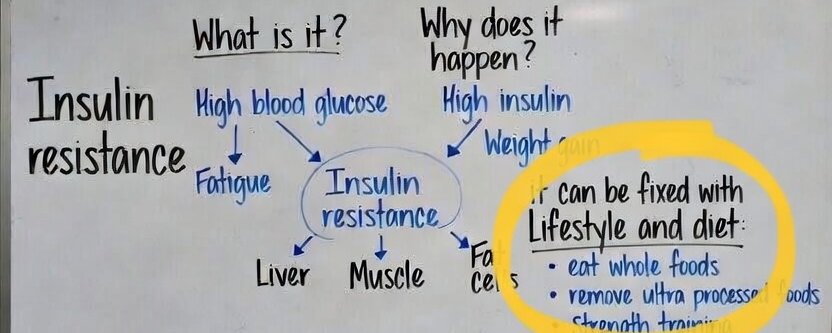
What is Insulin Resistance… and why should you care?

Insulin & Hormones
Why Counting Calories Doesn’t Work – And What Actually Does