Antinutrients: blockers, disruptors, and toxins
These articles are for information only. They are not medical advice, diagnosis, or treatment. Read the full disclaimer.
Informational only — not medical advice.
Bottom line first
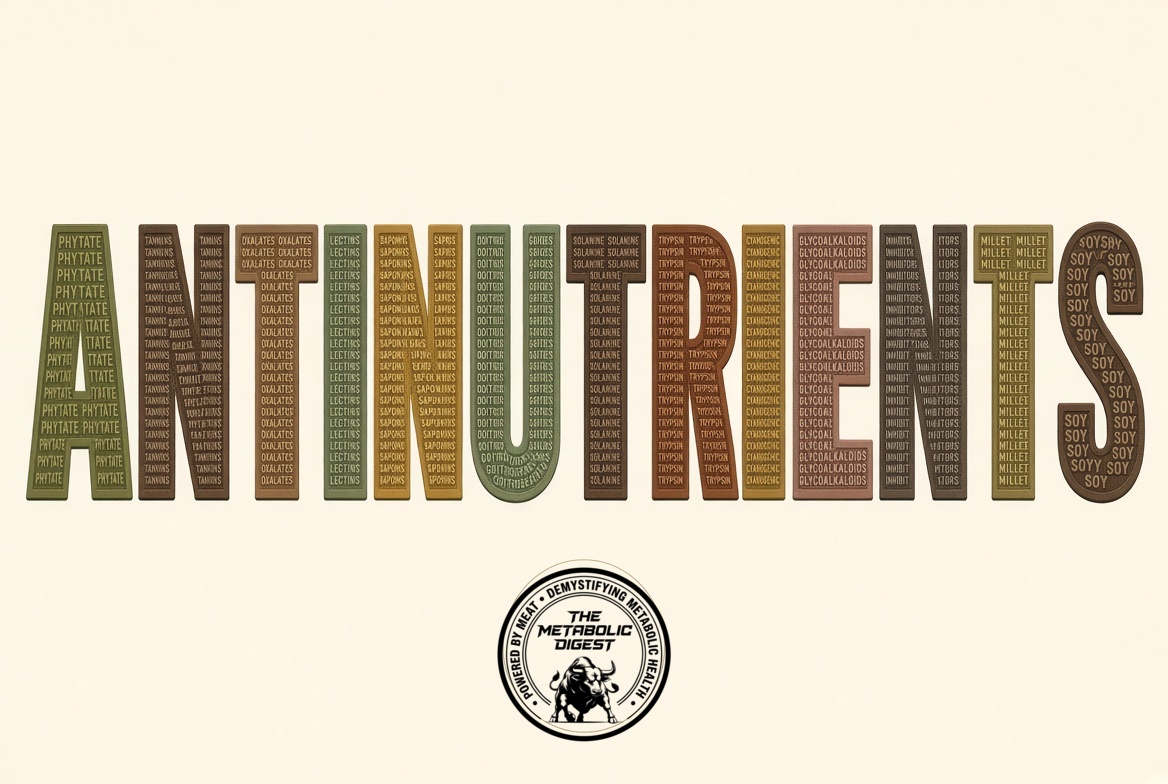
Antinutrients are compounds in plants that can lower mineral absorption, irritate the gut, or act as toxins at high doses. The size of the effect depends on the compound, the dose, the food, and how it is prepared. They are not a reason to avoid every plant. They are a reason to know what each one does and how ordinary kitchen steps change it.
What this page covers
Three groups, by effect:
1. Mineral absorption blockers
2. Cell disruptors
3. Straight-up toxins
Some compounds sit in more than one group. The list below notes the overlap. The page also covers where they are found, how ordinary kitchen steps lower them, how the effects are measured, and what breeding and processing do to the numbers.
Mineral absorption blockers
Phytic acid (phytate) binds zinc, iron, and calcium. It is found in whole grains, legumes, nuts, and seeds. In one classic feeding study, oysters eaten with beans or tortillas delivered less zinc than oysters eaten alone (Solomons et al., Journal of Laboratory and Clinical Medicine, 1979). Low-phytate maize work has shown the opposite direction: when phytate is reduced, more of the mineral is absorbed (Hambidge et al., American Journal of Clinical Nutrition, 2004).
Tannins are in tea, coffee, cocoa, and some fruits and grains. They can lower non-heme iron absorption from the same meal.
Oxalates are in spinach, rhubarb, almonds, and some other leafy greens. They bind calcium. The calcium in spinach is poorly available for that reason.
These three are measured with isotope labeling and crossover feeding trials in humans. Hallberg, Brune, and Heaney are among the main absorption references.
Cell disruptors
Lectins are in raw beans, lentils, and some grains. They can irritate the gut lining if the food is not cooked. Thorough cooking or fermentation inactivates most of them. Some lectins can also affect nutrient handling, so they overlap with the absorption group.
Enzyme inhibitors (trypsin inhibitors) are in soy, other legumes, and some grains. They reduce protein digestion until the food is heat-treated.
Saponins are in legumes and quinoa. At high doses they can affect gut permeability. Usual food amounts are lower. They also have some overlap with absorption effects in laboratory work.
Straight-up toxins
Glycoalkaloids (solanine and chaconine) are in green or sprouted potatoes and some nightshades. High amounts cause gastrointestinal and neurological symptoms. Peeling and discarding green parts lowers the load.
Goitrogens are in raw cruciferous vegetables such as kale, broccoli, cabbage, and Brussels sprouts, and also in soy and millet. At very high intakes they can interfere with iodine use in the thyroid, especially when iodine intake is low. Cooking lowers the effect (Gaitan et al., Journal of Clinical Endocrinology & Metabolism, 1989; Messina and Redmond, Thyroid, 2006).
Other compounds (cyanogenic glycosides in raw cassava, for example) are included only when the data are clear.
Where they are found
- Grains and legumes: phytate, lectins, enzyme inhibitors.
- Leafy greens and nuts: oxalates.
- Tea, coffee, cocoa: tannins.
- Potatoes (especially green): glycoalkaloids.
- Cruciferous vegetables, soy, and millet: goitrogens.
How to reduce them
Ordinary kitchen steps lower most of them:
- Soak and discard the water (phytate, some lectins, enzyme inhibitors).
- Cook thoroughly (lectins, enzyme inhibitors, goitrogens, some glycoalkaloids).
- Ferment (phytate, some lectins and enzyme inhibitors).
- Sprout, then cook (phytate and enzyme inhibitors).
- Pair with vitamin C or meat (improves non-heme iron absorption against phytate and tannins).
- Peel and discard green parts of potatoes (glycoalkaloids).
These steps do not remove every molecule. They lower the amount enough that ordinary mixed diets usually absorb enough minerals.
Dose and context
Most of the absorption data come from single-meal studies. A meal high in phytate lowers zinc or iron from that meal. It does not erase the mineral content of the whole diet. People who eat varied whole foods and meet their needs usually absorb enough. The risk is higher when the diet is monotonous, mineral intake is low, and preparation methods that reduce the blockers are missing.
Chronic high intake of refined forms
A practical inference, not a measured long-term outcome: when refined grain products or processed plant foods are eaten in large amounts day after day, they can keep the blockers while offering less of the mineral they bind. In people whose overall mineral intake is already low, that pattern may lower iron or zinc status over time. The direct data remain single-meal absorption studies. The inference is the combination—high blocker load, low mineral intake, and little preparation that reduces the blockers.
Breeding and processing
A 2026 soy breeding meta-analysis found that yield rose and protein fell from the 1920s to the 2010s. Phytic acid was largely untracked, so the paper does not support a claim that modern breeding raised antinutrients in soy (Mbambo et al., Plants, 2026).
A 2026 study of zinc-biofortified wheat found that milling to 70 percent extraction cut zinc about 70 percent, iron about 49 percent, and phytic acid about 79 percent. Fermentation cut phytic acid further. Processing can lower both the mineral and the blocker (Ibba & Govindan, Frontiers in Plant Science, 2026).
What this page is not
It is not a list of plants to avoid. It is not a claim that antinutrients cause disease in ordinary mixed diets. It does not upgrade single-meal absorption studies into long-term deficiency outcomes.
Do some thoughtful research. Your health, your responsibility.
The Metabolic Digest is an educational library about metabolic health and whole-food, animal-based ketogenic nutrition. Nothing on this site is medical advice, diagnosis, or treatment. Food, fasting, sleep, and training changes can affect medications, especially drugs that lower blood glucose. Individual responses vary. Consult a clinician who understands metabolic health before you change how you eat, train, fast, or read your labs. Your health is your responsibility.
Continue exploring