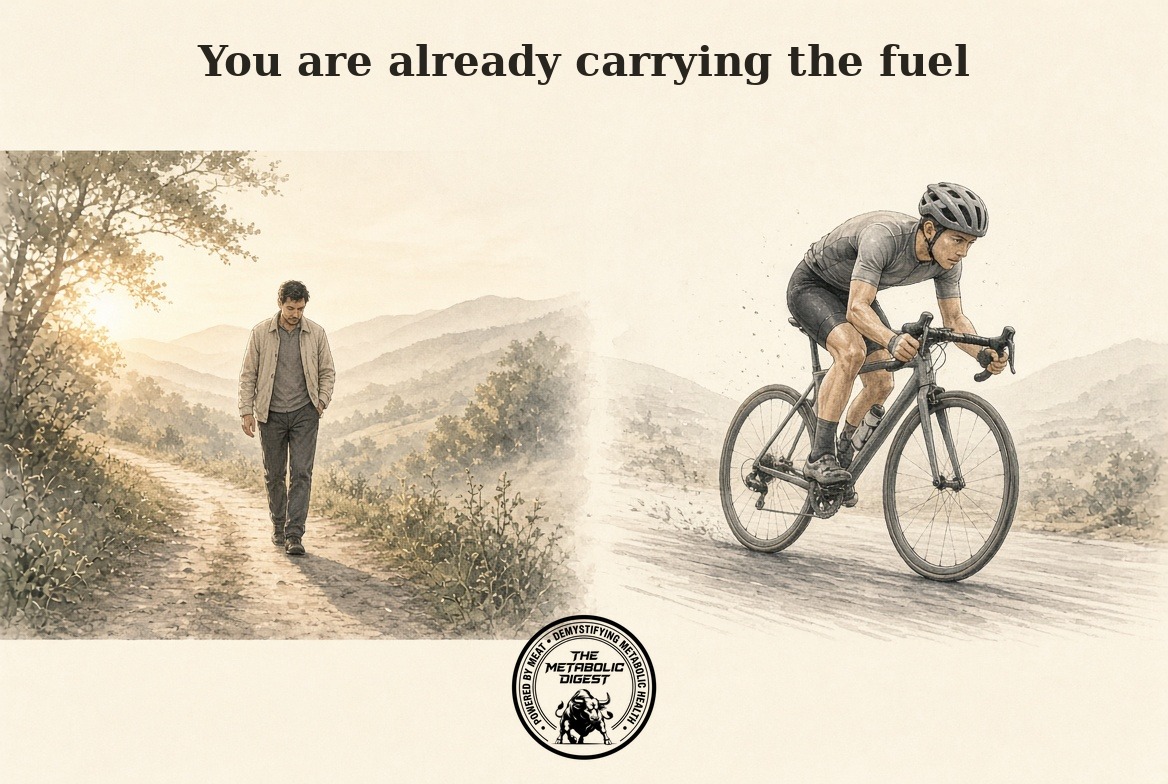
You are already carrying the fuel
These essays are for information only. They are not medical advice, diagnosis, or treatment. Read the full disclaimer.
Medical Disclaimer. This information is for educational purposes only and is not medical advice, diagnosis, or treatment. Always consult a qualified healthcare professional before making changes to your diet, lifestyle, fasting practices, or medications. Do not stop or change any prescribed treatment without your doctor's guidance. Individual responses vary, and what works for one person may not be safe or effective for another.
THE STUDY
This page starts from one paper. Martyn and colleagues gave eight trained male cyclists carbohydrate drinks at 10, 90, 120, and 150 grams an hour, then timed the ride (Martyn et al., Medicine & Science in Sports & Exercise, 2026). The numbers here are from the abstract. The full paper is still behind a paywall. The dose, the time, and the limits of that lab are what the rest of this page is about.
BOTTOM LINE FIRST
A high-carb lab just found a ceiling on drink carbs, and the ceiling was not "more." Eight trained men rode bikes for about three hours. Once they were taking about 90 grams of carbohydrate an hour, 120 and 150 grams did not buy them a longer ride. The point for this site is older than the gel packet. You already carry a large fat store. Glycogen is the small, fast tank. Easy work can run on the fat you walked in with. A gel is a tool for hard, long work, not a requirement for a walk.
WHAT THE LAB ACTUALLY DID
Martyn and colleagues gave trained male cyclists carbohydrate drinks at 10, 90, 120, and 150 grams an hour. The rides were three hours at a steady effort, then a push to exhaustion. The 90, 120, and 150 gram trials were randomized. The 10 gram trial was the first visit, a practice ride, so it is not a fair comparison with the later rides.
Eight men. Cyclists. No women. One lab. That is a narrow group, and it is not a final answer. The paper summary does not say how much fat they burned.
WHAT THEY FOUND
The drink was burned. At 90 grams an hour the riders oxidized about 1.23 grams of that drink per minute. At 120 it was 1.48. At 150 it was 1.62. Total carbohydrate use rose from about 2.3 grams a minute at 90 to 2.6 at 120, then stayed at 2.6 at 150. The 120 and 150 totals were the same.
Time to exhaustion was about 3 hours 5 minutes at 90 grams, 3 hours 5 minutes at 120, and 3 hours 1 minute at 150. No difference among those three. The 10 gram ride was shorter, about 2 hours 41 minutes. That gap against 150 grams was not strong enough to call a clear result. A dose of 150 grams an hour did not show a shorter ride than 90 or 120. The authors' model put the useful dose near 107 grams an hour, with a range of about 92 to 122. Their line was that 150 grams of carbohydrate an hour adds nothing, and that the dose should be personal.
In plain words: once these riders had about 90 grams of carbohydrate an hour, more did not make the ride longer. 150 grams of carbohydrate an hour added nothing.
THE FUEL YOU ALREADY CARRY
Glycogen is carbohydrate stored mainly in muscle and in the liver, with smaller amounts in other tissues. It is a small tank. A few hundred grams, even in a trained person. Fat is the large tank. A lean adult is walking around with a large store of potential energy in body fat. That is not a metaphor. It is the store.
The glycerol in fat can be turned into glucose. The fatty acids are burned, or broken down and rebuilt into other fats the body can use. Better yet, that store can be broken down for a life, not only for a ride.
The ancestral line is a hypothesis, not a finding of this study. For most of human time, a long walk or a hunt was not fed by a bottle every fifteen minutes. The body had to be able to do easy, lasting work on the fat it already held. This paper does not test that life. It does show that, in these cyclists, raising the drink from 120 to 150 grams an hour did not raise total carbohydrate use and did not add time. Total carbohydrate use was higher at 120 than at 90. Time was not.
In this abstract, carbohydrate from the drink kept rising from 120 to 150 grams an hour while total carbohydrate use stayed flat. The extra drink did not show up as extra fuel burned. Reading that as the drink replacing the body's own carbohydrate is an inference from those two numbers, not a separate result.
EASY WORK AND HARD WORK
Match the fuel to the work. A walk, a hike, an easy spin: the fat store can cover it. A fasted easy session is a reasonable experiment for a person who is already used to it and feels well. It is not a rule for every session, and it is not a treatment. Intensity decides. A hard, long ride is a different job from an easy hour.
Hard, long efforts are a different job. These cyclists went longer on 90 grams an hour than on 10. Carbohydrate during the ride was not useless. Past a point, more did not help these men. Race pace is a further limit. Elite race-walking work has found a cost to a ketogenic diet at the intensities those athletes race at. That is not a claim that a ketogenic diet matches carbohydrate at race pace.
Working muscle can take up glucose largely without insulin. That is why a gel in a long event is not the same problem as a sugary day at the desk. The insulin-resistance essay is about the all-day demand. This page is about a session. They are not the same sentence. See What is Insulin Resistance.
WHAT TO DO WITH THIS INFORMATION?
This is a training idea, tied to how hard the session is. It is not a plan for every person, and it is not one dose for every ride.
Carbohydrate is not an essential nutrient. The body can make glucose. That is a different sentence from "a gel never helps." In this lab, the short dose did not last as long as 90 grams an hour. Dietary carbohydrate can be unnecessary on an easy day and still useful when the work is long and hard. Necessary for a session is not the same thing as essential in the diet.
Acclimation matters, and this trial did not include a person who has spent months burning fat. The abstract does not say these riders were used to high-carbohydrate feeding. It only describes trained male cyclists. Illness, glucose-lowering drugs, and a new way of eating all change the application. The science is the ceiling in these eight men. The application is the session in front of you.
If the session is easy, you may not need a gel to start. You carried the fuel in. If the session is long and hard, a drink can extend the work, and this lab's own ceiling was near 90 to 120 grams an hour, not 150. If you use glucose-lowering drugs, a change in training food is a prescriber conversation, not a self-experiment. Your health, your responsibility.
POSTSCRIPT
Martyn, Gonzalez, Stellingwerff, Burke, Owens, Pugh, and Morton, Medicine & Science in Sports & Exercise, 2026. Abstract only.
Working muscle and insulin: Richter and Hargreaves, Physiological Reviews, 2013.
Fat-adapted athletes, other work, not this trial: Phinney and colleagues, 1983. Volek and colleagues, FASTER, Metabolism, 2016.
The cost at race pace: Burke and colleagues, 2017 and 2020, elite race walkers.
Also on this site: Why Animal Fat Is Not the Enemy. Cardiovascular Training vs Resistance Training.
Also discussed on X: @metabolicdigest. Also on Instagram: @metabolic_digest. Both are communication platforms. The library is this site.
Medical Disclaimer. This information is for educational purposes only and is not medical advice, diagnosis, or treatment. Always consult a qualified healthcare professional before making changes to your diet, lifestyle, fasting practices, or medications. Do not stop or change any prescribed treatment without your doctor's guidance. Individual responses vary, and what works for one person may not be safe or effective for another.
This article is for informational purposes only. Full disclaimer: /disclaimer
Your health, your responsibility.
Continue exploring