
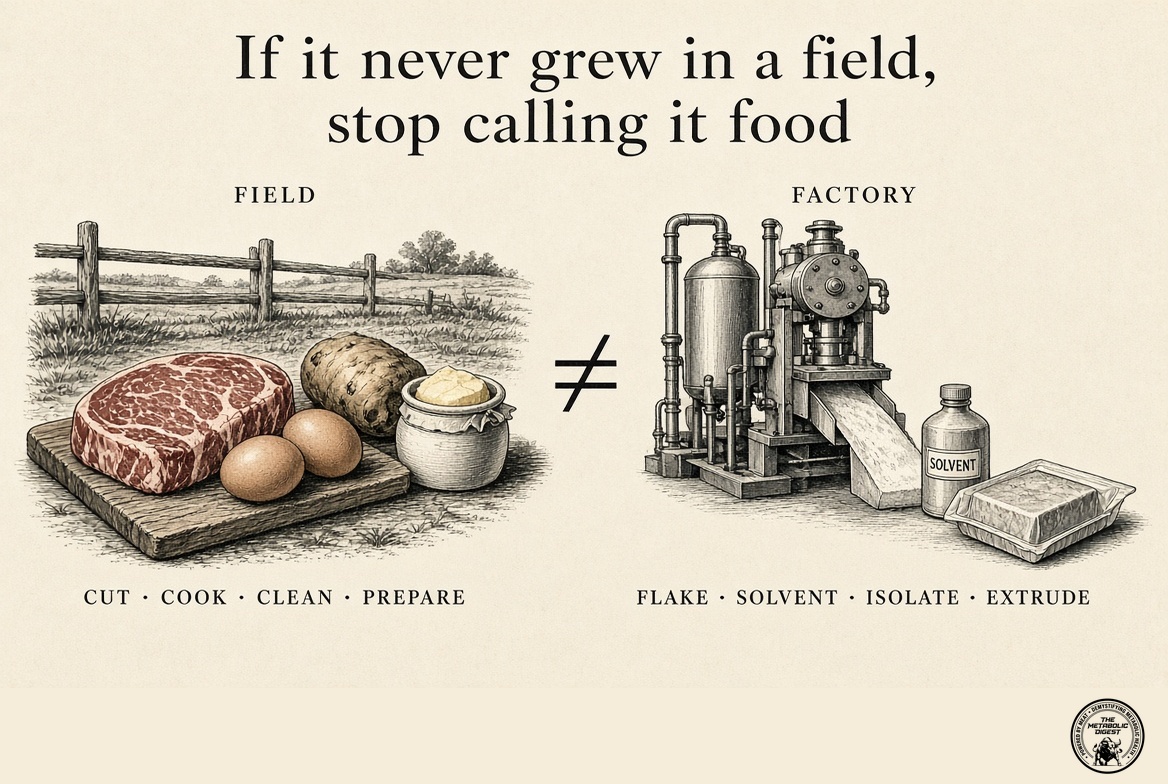
If it never grew in a field, stop calling it food
These essays are for information only. They are not medical advice, diagnosis, or treatment. Read the full disclaimer.
Bottom Line First
A useful filter: could this have come from a field, a pasture, or an animal — or did it need a factory to exist at all? Real food takes very few steps to finish at home. Meat: butcher it and cook it. A plant: grow it, clean it, and prepare it in the kitchen. Seed oils, fiber isolates, and most “milks” squeezed from seeds fail because you cannot finish them that way. This is not a claim that every factory product is poison. It is a claim that you should know what the object actually is before you trust the costume. The test is not nostalgia. It is a way to see processing before you read the health claim on the front of the box.
Medical Disclaimer. This information is for educational purposes only and is not medical advice, diagnosis, or treatment. Always consult a qualified healthcare professional before making changes to your diet, lifestyle, fasting practices, or medications. Do not stop or change any prescribed treatment without your doctor's guidance. Individual responses vary, and what works for one person may not be safe or effective for another.
What the test is asking
Look at the thing in your hand.
Did a plant grow it? Did an animal make it? Could a kitchen, a farm, or a butcher finish it without a chemical plant?
If the answer is yes, it can still be cooked, salted, aged, or canned. That is processing. Humans have done that for a long time.
If the answer is no — if the product only exists because a factory fractioned a crop into powder, solvent-extracted an oil, isolated a protein, then glued the pieces back together with flavors — call it what it is. It is an industrial formulation wearing a food costume.
This page does not say every farm food is perfect. It does not say every item that touched a factory is terrible. Canning, pasteurizing, and a butcher’s saw are industrial tools. The point is understanding what you are holding: a short kitchen chain, or a formulation assembled from fractions. The label’s story is not the first fact. The first fact is how the thing was made.
What “field” includes
Field, here, is shorthand.
- Muscle, fat, organs, eggs, and dairy from animals.
- Plants you can still recognize as plants. A potato is still a potato.
- Kitchen steps that do not invent a new substance: heat, salt, smoke, ferment, dry, grind, churn.
Butter is cream that was churned. Cheese is milk that was cultured and pressed. Those are old crafts. They start with an animal.
A ribeye does not need an ingredient panel to exist. Neither does an egg.
Finish it at home
This is the part of the test that matters in a kitchen.
If it is food, the last steps are short and you can do them yourself.
Meat. An animal grew it. A butcher (or you) separate the parts you will eat. You cook it with heat. That is the chain: grow on the animal, cut, cook. You do not need a solvent, an extruder, or a flavor lab to make steak edible.
A plant. It grew in soil or on a vine. You harvest it. You wash off dirt. You cut it, cook it, or eat it raw if that plant is safe raw. That is the chain: grow, clean, prepare. A potato is still a potato after you scrub it.
Eggs. The bird laid them. You crack them and cook them.
Milk from an animal. An animal made it. You can drink it, ferment it, or churn the cream into butter. Those are kitchen or dairy-craft steps, not a chemical plant.
Count the steps. Two, three, maybe four. Grow. Separate or clean. Cook. That is food.
If you cannot finish the product that way — if the only path to a bottle or a bar is flaking, solvent extraction, isolation, extrusion, and a flavor system — you are not looking at a short kitchen chain. You are looking at a factory chain. The factory is not “cooking.” It is building a new object out of fractions.
You can still buy a butcher’s work or a farmer’s wash-and-pack. That is not the same as buying a formulation. One shortens the home steps. The other replaces them.
What “factory” includes
Factory, here, means the product required industrial steps that a home kitchen does not have.
Researchers who study this use a system called NOVA. Carlos Monteiro and colleagues group foods by how and why they were processed, not by a calorie count. Group 1 is unprocessed or barely processed food. Group 4 is ultra-processed food: formulations built from substances of little or no kitchen use — protein isolates, hydrogenated or interesterified oils, high-fructose corn syrup, modified starches — plus cosmetic additives (flavors, colors, emulsifiers, sweeteners) that make the mix palatable. Extrusion, molding, and pre-frying are typical of that world.
You do not have to memorize NOVA to use the field test. The two overlap, but they are not identical. NOVA puts plain oils, butter, sugar, and salt in their own group, called processed culinary ingredients, and that includes refined seed oils. It flags a product as ultra-processed when the ingredient list includes things a kitchen never uses, such as soy protein isolate, maltodextrin, high-fructose corn syrup, added soluble or insoluble fibre, or hydrogenated or interesterified oil. The field test is stricter on seed oils, because it asks whether a kitchen could make the thing at all.
Examples that fail the test
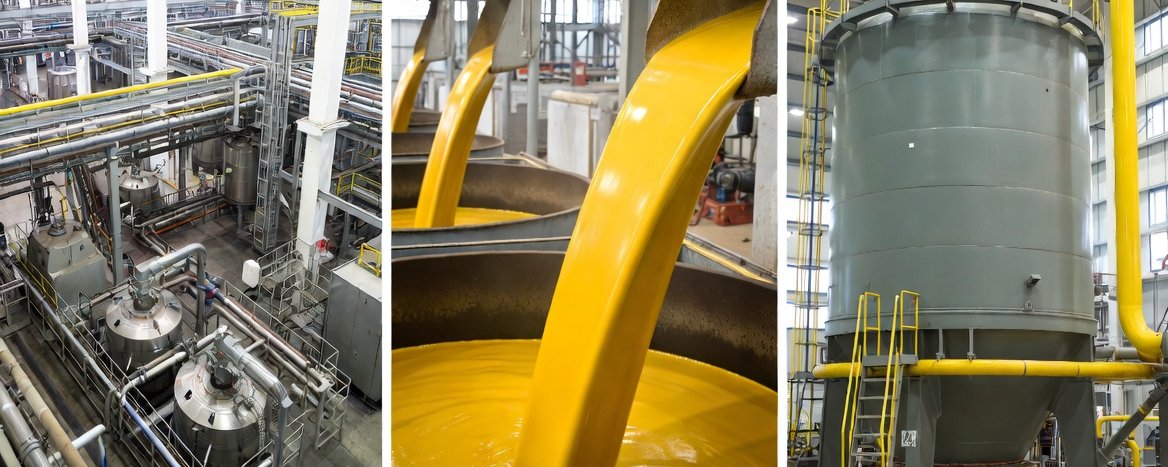
Seed oils. Canola, soybean, corn, cottonseed, and sunflower oils are not something a kitchen can make. Most commercial seed oil is made by flaking and cooking the seed, pressing it, then washing the leftover cake with hexane, a petroleum solvent, to pull out the rest of the oil. The crude oil is then refined, bleached with clay, and steam-deodorized. A small share is sold expeller- or cold-pressed without solvent, but that is not what fills the cheap bottles or the ingredient lists. That is a refinery product. The longer story is in Why Seed Oils Are a Hidden Driver of Metabolic Problems.
Isolated fiber. The powder added back to a cereal or a “keto” bar did not grow as that powder. Ancestral humans never needed a fiber supplement or a fortified cereal. Whatever fiber they ate came packed inside whole foods, and how much depended on where they lived. Isolated, factory-made fiber added back to refined carbs is a modern fix for a modern product. Read that case on the site: The Fiber Fight: Industry's Modern Workaround for Refined Carbs.
Most seed “milks.” You cannot milk an almond or an oat. You can grind nuts or oats with water and strain them at home, and that is a short kitchen chain. The cartons on the shelf are usually something else: gums, added seed oil, flavors, and in oat drinks, enzymes that break the oat starch down into maltose, a sugar. That is a formulation.
Protein isolates and replica meats. A patty built from soy isolate, seed oil, binders, and flavor systems is not a steer. Absorption and amino-acid quality still favor the animal that grew the meat. See It’s Not Just the Protein You Consume. The full replica-meat case is in Plant-based meat is not a metabolic upgrade. This page only plants the test.
Examples that pass — with a note
Steak, fish, eggs, butter, and unsweetened yogurt pass.
Salted or smoked meat can still pass. That is old preservation, closer to NOVA’s processed group than to ultra-processed formulations.
A problem starts when the meat is broken into slurry, mixed with isolates and seed oils, extruded, and dyed. Then it has left the field.
Why the test exists
Front-of-pack language sells a feeling: heart, plant, fiber, protein, “made with.”
The field test ignores the feeling and asks a construction question. If the product could not exist without a factory that fractionates crops into industrial ingredients, the health claim is advertising on top of a formulation. That still does not make every factory-touched food a moral failure. It makes the ingredient list more important than the slogan.
That matters for insulin and satiety because many factory foods are easy to eat past fullness: refined starch, refined sugar, refined fat, weak protein, little chew.
For some people it goes further than easy overeating. A 2023 BMJ analysis pooling earlier studies estimated that addiction-like eating of ultra-processed foods high in refined carbohydrates and added fats shows up in roughly 14% of adults (Gearhardt et al., 2023), and a 2025 expert consensus agreed it has the features of a substance-use disorder (Unwin et al., 2025). The estimates come from questionnaire surveys, and it is not yet an official diagnosis, but the pattern is hard to ignore.
Source: Gearhardt AN et al. BMJ 2023;383:e075354. doi:10.1136/bmj-2023-075354. Unwin J et al. Front Psychiatry 2025;16:1542905. doi:10.3389/fpsyt.2025.1542905.
The hormone story is in What is Insulin Resistance and Why Counting Calories Doesn’t Work. This page does not repeat those essays. It gives you a filter you can use in an aisle in ten seconds.
What the test is not
It is not a religion of raw food.
It is not a claim that every wild plant is safe.
It is not proof that animal fat “protects the heart on its own.” Traditional diets rich in animal fat were whole-food diets without refined carbs or seed oils. That limit is already in Why Animal Fat Is Not the Enemy.
It is not a diagnosis.
A 10-second check
1. Could you finish this at home in a few steps: butcher and cook, or grow, clean, and prepare?
2. Could a farmer, a fisherman, or a hunter have handed you this without a chemical plant?
3. If there is a long ingredient list, how many of those words are things you cook with?
4. If the front says “plant-based” or “heart-healthy,” turn the box over before you believe it.
If step 1 is no, you are not holding a field food. You are holding a factory product. Eat or don’t eat — that is your call. Just do not let the costume choose for you.
Simple takeaway
Food that grew on a field, a pasture, or an animal is not the same object as a formulation assembled to look like food. Know which one you are holding. That is the point — not a ban on every factory. Use the test. Then read the essays linked here if you want the mechanism.
Do some thoughtful research.
Your health, your responsibility.
Postscript: People and papers (not a treatment list)
Gearhardt AN et al. BMJ 2023;383:e075354. doi:10.1136/bmj-2023-075354. Unwin J et al. Front Psychiatry 2025;16:1542905. doi:10.3389/fpsyt.2025.1542905.
Monteiro C.A. and colleagues. NOVA classification of ultra-processed foods. See FAO booklet “Ultra-processed foods, diet quality, and health using the NOVA classification system” (2019) and Monteiro et al., Public Health Nutrition 2019, doi 10.1017/S1368980018003762. Group 4 is formulations of industrial ingredients plus cosmetic additives — not a nutrient score.
Seed-oil process context: industrial crushing and solvent extraction of oilseeds is standard manufacturing, described by the Canola Council of Canada (canolacouncil.org/about-canola/processing/) and university extension notes. For how much seed it takes to fill one bottle, see Why Seed Oils Are a Hidden Driver of Metabolic Problems.
The related essays on this site cover insulin, fiber isolates, protein quality, animal fat, and seed oils in depth. This page is the filter.
This page is the source. The public library is this site.
This article is for informational purposes only. Full disclaimer: /disclaimer
Your health, your responsibility.
Continue exploring
Related reading.

Food Quality
Why Animal Fat Is Not the Enemy
Food Quality