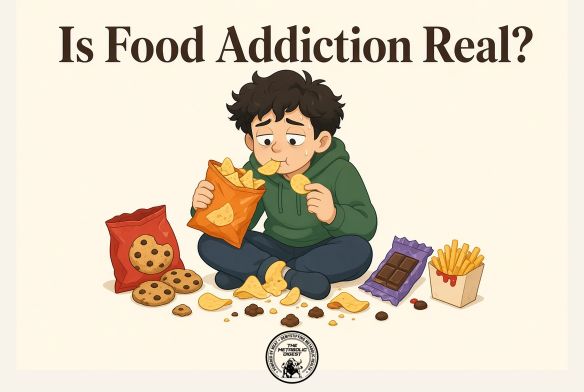
Is Food Addiction Real? What the Evidence Says — and Why Isn't Meat by Itself on the List
These articles are for information only. They are not medical advice, diagnosis, or treatment. Read the full disclaimer.
Informational only — not medical advice.
Bottom line first
Food addiction is a real pattern for many people. The foods they most often lose control over are combinations of refined carbohydrate and fat, made to be hard to stop eating - plain meat is not on that list. Eating these foods day after day is linked to more intake and poorer metabolic health. Different approaches exist through professional practice, including support, education, and medical testing. The pattern is real enough that it should be studied more closely.
What this page covers
A plain look at the pattern, the foods that drive it, why plain meat does not, and what happens when people try to stop.
Is the pattern real?
Food addiction is a pattern many people report: strong cravings, loss of control, and repeated failed attempts to cut back on certain foods. Researchers use a questionnaire called the Yale Food Addiction Scale to study it. Scoring high on that questionnaire is not a diagnosis. It is a research tool. Large reviews have used it. They show the pattern is common enough to notice. The health effects that follow chronic overconsumption of these foods are also real.
Some researchers treat the problem as addiction to certain foods. Others treat it as a behavioral pattern of eating. Both sides agree the pattern exists in some people. They disagree on the best name for it.
Why these foods are overconsumed
In one survey, people rated processed foods high in fat and sugar as the ones they found hardest to stop eating. Plain meats ranked low. The foods that scored highest were the ones designed to be highly palatable.
If you are a meat eater, you already know the next point. Given a large quantity of plain meat, say two pounds of steak, you start to feel full and stop wanting more. You would not circle back a short while later to finish it. Carbohydrate-heavy foods do not work the same way. After you have met your fill with the steak, you can still eat dessert. That is the old line about “saving room for dessert.”
A small study in men found that a high-glycemic meal left them hungrier four hours later than a matched lower-glycemic meal. Brain scans showed more activity in a reward area after the high-glycemic meal.
In a laboratory test, people paid more for foods that mixed fat and carbohydrate than for foods that were fat-only or carbohydrate-only, even when the calories and liking were matched. The combination was more rewarding than either part alone.
An inpatient study compared an ultra-processed diet with a matched unprocessed diet. People ate about 500 extra calories a day on the ultra-processed diet and gained weight over two weeks. The foods were matched for calories, sugar, fat, and salt. The difference was the processing and the combination of ingredients.
The common thread is the combination of refined carbohydrate and fat. That combination drives higher ratings of craving and higher short-term intake. Plain meat does not.
Chronic consumption and health
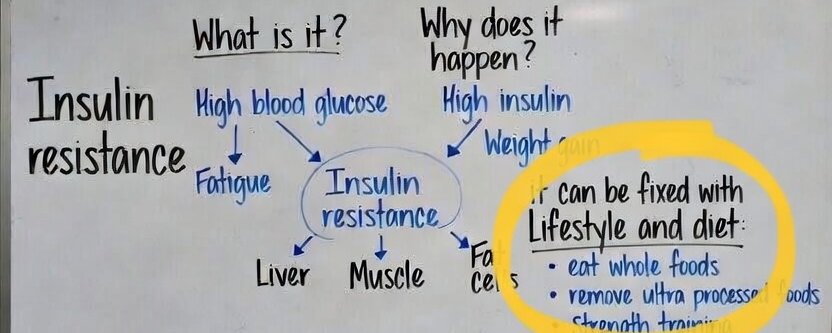
When these foods are eaten in large amounts, day after day, two things happen. First, people tend to eat more total energy potential than they need. Second, the pattern is linked to higher rates of weight gain (by way of increased body fat), insulin resistance, and other metabolic problems. The foods are engineered so that ordinary portions do not satisfy. The result is chronic overconsumption of foods that are already low in nutrients and high in rapidly absorbed carbohydrate and fat.
Designed to be hard to stop
Researchers have defined hyper-palatable foods by three nutrient clusters: fat plus salt, fat plus sugar, and carbohydrate plus salt. A large share of the packaged foods in the U.S. food supply meet at least one of those clusters. The definition is about the nutrient mix, not about a processing label.
Foods once owned by tobacco companies were more likely to meet those clusters. The link is from ownership records. It is not a statement of intent. Investigative books have described industry practices such as the “bliss point” and the layering of sugar, fat, and salt. Those accounts are journalism. The measured record is the higher intake and the higher craving ratings for the combinations.
What happens when people try to stop
Different approaches exist through professional practice. Some programs use abstinence from sugar and flour. One online peer-supported program (Liberate) found that people who completed it reported lower craving scores and fewer binge-eating symptoms at six months. Another low-carbohydrate program that included psychoeducation also saw lower questionnaire scores and some weight loss. Clinicians working in this area use support, education, and medical testing to help people identify trigger foods and manage the pattern. Neither program has been tested against a control group in a trial. No head-to-head comparison exists.
What animal studies show
Rats given intermittent access to sugar show bingeing and withdrawal-like signs. Rats given free access to a high-fat cafeteria diet show changes in dopamine receptors and compulsive-like eating. These studies show that certain schedules and foods can produce addiction-like changes in rodents. They do not show that a person who eats normally becomes dependent on sugar.
What this page is not
It is not advice to treat an eating disorder without a clinician. It does not claim that any one approach has been proven best. It does not call seed oils ultra-processed.
Postscript — sources
Schulte, Avena, and Gearhardt, PLOS ONE, 2015. Ratings of which foods people find most addictive.
Lennerz et al., American Journal of Clinical Nutrition, 2013. High-glycemic meal and hunger four hours later.
DiFeliceantonio et al., Cell Metabolism, 2018. Fat-plus-carbohydrate foods valued more than either alone.
Hall et al., Cell Metabolism, 2019. Ultra-processed diet and higher daily intake.
Fazzino et al., Obesity, 2019. Definition of hyper-palatable foods.
Fazzino et al., Addiction, 2024. Tobacco-owned foods and hyper-palatable clusters.
Bennett et al., Frontiers in Psychiatry, 2025. Liberate feasibility study.
Unwin et al., Frontiers in Psychiatry, 2022. Low-carbohydrate psychoeducation audit.
Avena, Rada, and Hoebel, Neuroscience & Biobehavioral Reviews, 2008. Rat sugar studies.
Johnson and Kenny, Nature Neuroscience, 2010. Rat cafeteria-diet study.
Gearhardt et al., BMJ, 2023. Analysis of ultra-processed food addiction.
Fletcher and Kenny, Neuropsychopharmacology, 2018. Debate on substance versus behavioral addiction.
Hebebrand et al., Neuroscience & Biobehavioral Reviews, 2014. Proposal of “eating addiction.”
Do some thoughtful research. Your health, your responsibility.
The Metabolic Digest is an educational library about metabolic health and whole-food, animal-based ketogenic nutrition. Nothing on this site is medical advice, diagnosis, or treatment. Food, fasting, sleep, and training changes can affect medications, especially drugs that lower blood glucose. Individual responses vary. Consult a clinician who understands metabolic health before you change how you eat, train, fast, or read your labs. Your health is your responsibility.
Discuss on Instagram: @metabolic_digest
Continue exploring
Related reading.
Food Quality
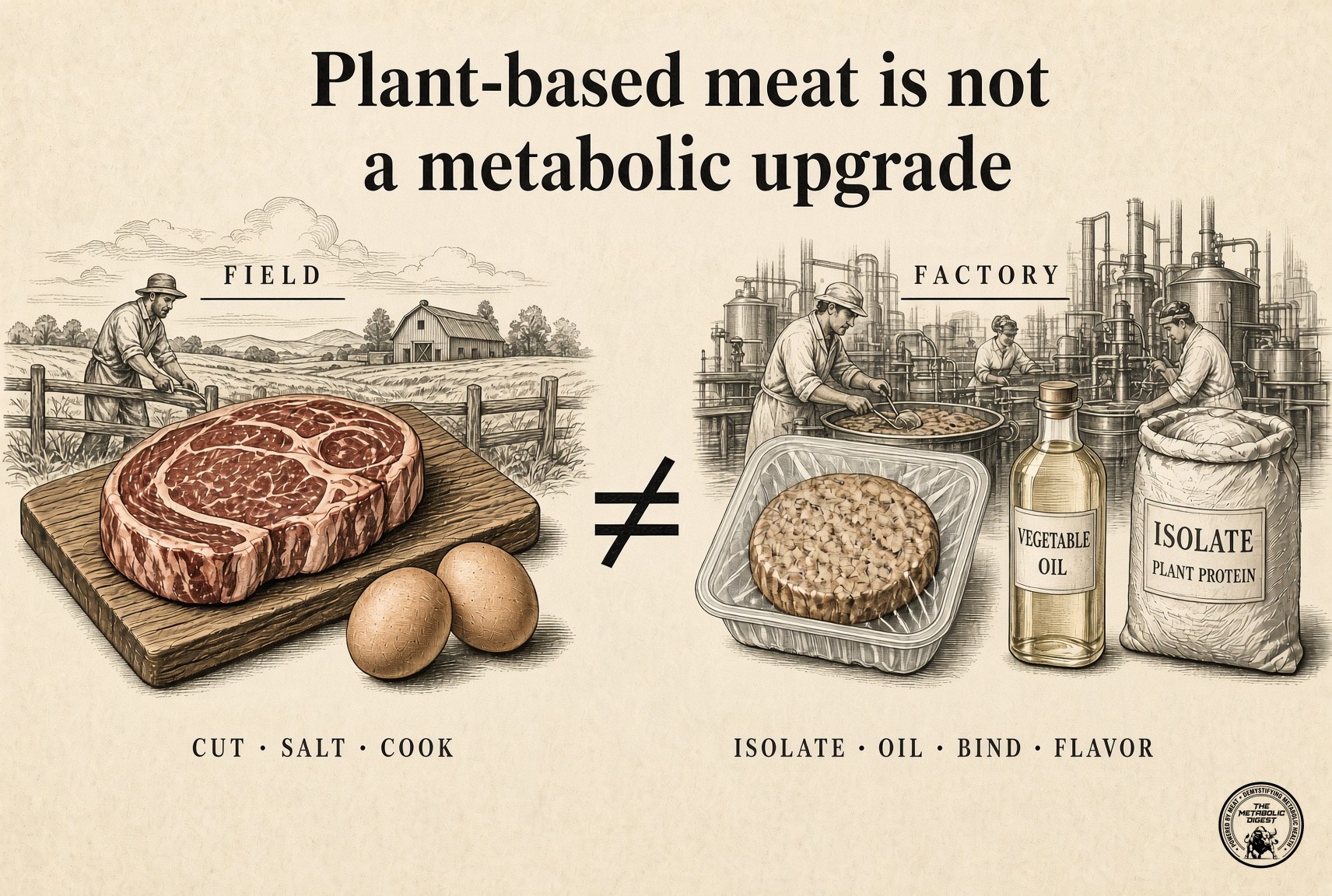
Plant-based meat is not a metabolic upgrade
Insulin & Hormones