What are Ultra-Processed Foods?... and How to Read an Ultra-Processed Label, One Line at a Time
These articles are for information only. They are not medical advice, diagnosis, or treatment. Read the full disclaimer.
Informational only — not medical advice.
Bottom line first
Read the ingredient list, not just the promise on the front. A low-carb bar, protein chip, or keto loaf can be an ultra-processed product too.
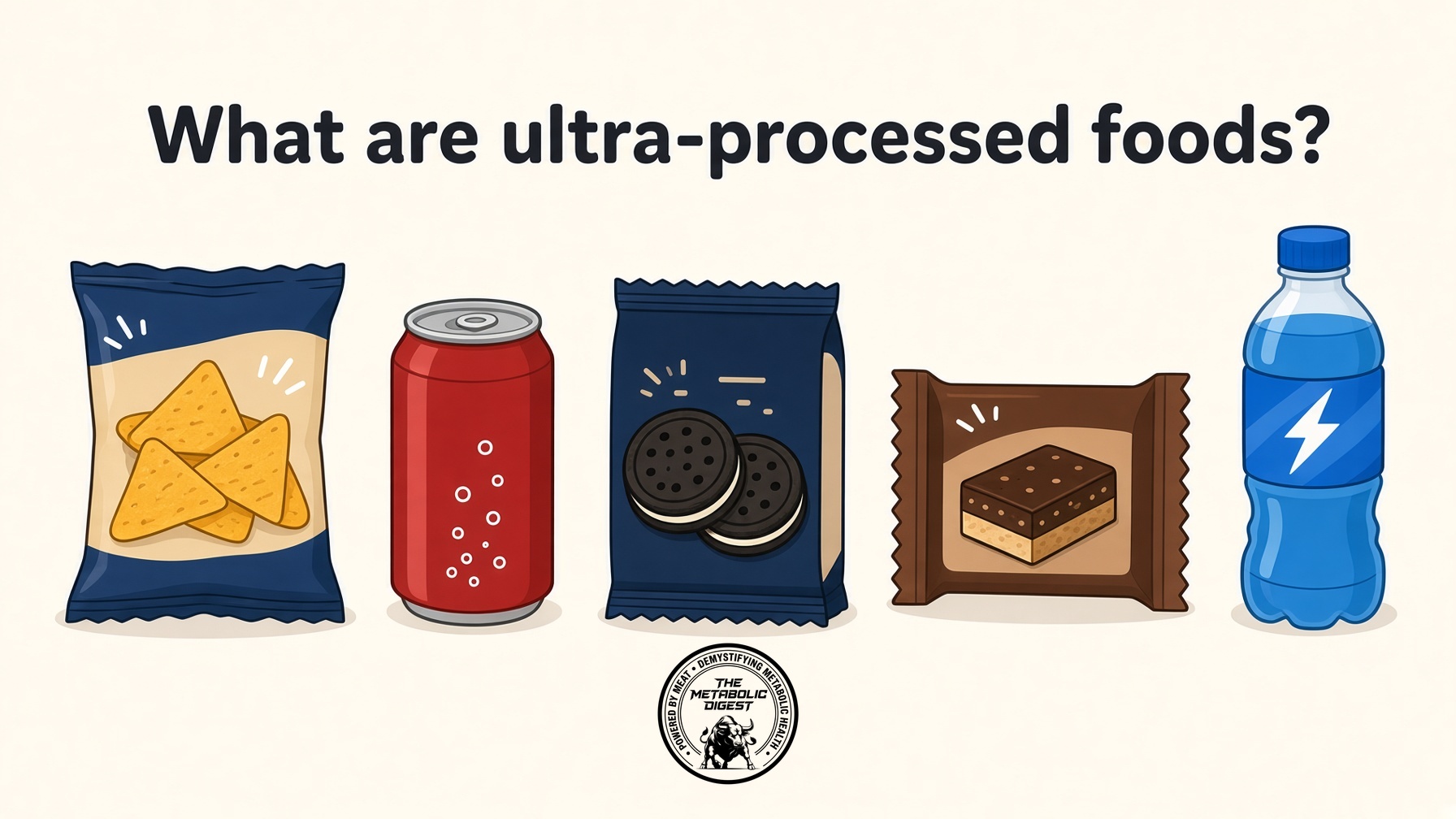
Ultra-processed foods are industrial formulas built from substances taken out of foods, often with additives for flavor, color, and texture. That tells you something about how they were made. It does not prove that every ingredient is harmful.
The goal here is simple: know what you are eating, where its ingredients come from, and what they do. Then decide for yourself.
What NOVA means — and what it does not
Researchers use NOVA to group foods by processing:
Group 1: unprocessed or minimally processed foods, including plain meat, eggs, vegetables, and milk.
Group 2: processed culinary ingredients, including salt, sugar, butter, and plain oils. Seed oils belong here, not in the ultra-processed group.
Group 3: processed foods made with relatively simple combinations, such as cheese or vegetables preserved with salt.
Group 4: ultra-processed formulations.
The Monteiro et al. 2019 guide identifies ingredients that help distinguish Group 4. These include protein isolates, gluten, maltodextrin, high-fructose corn syrup, added fiber, and additives used to shape a product’s taste, appearance, or texture.
One recognized marker is enough under that guide. But not every additive is a marker. Salt, table sugar, vinegar, and a preservative do not automatically turn a food into Group 4. A long name is not a safety test, either.
Six ingredient families worth knowing
1. Sweeteners and refined carbohydrates
High-fructose corn syrup starts as corn starch. Enzymes turn it into a mixture containing glucose and fructose. Common types contain 42% or 55% fructose, with the rest glucose. Table sugar is half fructose and half glucose, so the proportions are similar. Dextrose is glucose, often made from corn starch. Both supply sugar, though they can serve other jobs in a recipe.
Sucralose, acesulfame potassium, stevia extracts, and erythritol provide sweetness with little or no energy potential. They are not all the same substance and should not be treated as one health claim. Just because a non-nutritive sweetener does not raise blood glucose or insulin in the short term does not mean it cannot affect the body in other ways. Dosage and frequency can influence the outcome. Some people report digestive changes or changes in taste preference with regular use. Others do not. The research is mixed, and individual responses vary.
Maltodextrin deserves its own explanation. It is starch broken into shorter chains. It is mainly used to add bulk, carry powdered flavors, or change texture — not simply to make food sweet. It supplies digestible carbohydrate even when a product does not taste sugary.
Plain table sugar is NOVA Group 2. Finding sugar alone is not enough to classify a product as ultra-processed.
2. Emulsifiers and thickeners
An emulsifier helps oil and water stay mixed. A thickener changes how a food pours, spreads, or feels in your mouth.
Examples include lecithin from soy or sunflower, guar gum from a bean, carrageenan from red seaweed, and cellulose gum made by modifying plant cellulose. Mono- and diglycerides are made from fats.
These ingredients help a shake stay smooth, a sauce stay mixed, or a bar stay chewy. Knowing that job is useful. It is not the same as proving harm at the amount you eat.
3. Preservatives and dough helpers
Calcium propionate and potassium sorbate help slow mold growth. Bread recipes may also use enzymes, ascorbic acid, or calcium peroxide to change dough handling and the finished loaf.
“Clean-label” bread may use cultured wheat flour or vinegar instead of some familiar preservative names. The label may sound more homemade, but the ingredients still have jobs to do.
Preservation is not automatically ultra-processing. Salt, drying, and fermentation preserve food too. Look at the whole recipe, not just the fact that it lasts.
4. Colors
Red 40, Yellow 5, and Yellow 6 are synthetic dyes. Caramel color is made by heating carbohydrates. Other colors come from plants, such as paprika extracts.
Their job is appearance. They are designed to make the product look appealing. They provide no positive nutritional value. Research on their effects in the body is mixed. Some studies have looked at hyperactivity in children and at possible effects on the gut microbiome. Results are not consistent. Under NOVA, colors count as a class whether they come from plants or a lab. A lab-made dye is not proof of harm at the amount in one product.
5. Flavors and flavor enhancers
In the US, “natural flavor” does not mean a whole food was added. The term is a regulatory category. It means the flavoring substances were derived from a plant or animal source rather than synthesized entirely in a lab. It does not mean the ingredient is the original food, and it does not mean the process was simple. A natural flavor can be a concentrated extract, a distilled fraction, or a blend of many compounds. The label does not have to list the individual substances inside the flavor. That is why the term is ambiguous: it tells you the origin category, not the actual composition or the amount of processing that went into it.
Monosodium glutamate — MSG — boosts savory taste. Disodium inosinate and disodium guanylate can strengthen that effect. Yeast extract can also add savory flavor.
These ingredients help make taste strong and repeatable. They do not tell you, on their own, whether the finished product causes overeating or addiction.
6. Rebuilt starches, proteins, and fats
Modified starches are changed by physical, chemical, or enzyme treatments so they behave differently — for example, holding water or keeping a product soft.
Protein isolates separate protein from much of the original food. Milk, whey, soy, and wheat isolates can help turn a snack into a high-protein product.
Hydrogenation changes fats to make them more solid. Interesterification rearranges their fat molecules to change how they behave. These processes are different; the names should not be used as if they mean the same thing.
These ingredients are useful clues to industrial formulation. Plain seed oil is a separate matter: NOVA Group 2.
A worked example: Doritos Nacho Cheese
The Doritos ingredient list from CVS (checked November 2026) shows how several families come together:
| Label ingredient or group | What it contributes |
|---|---|
| Corn | The chip’s main material |
| Vegetable oil | Frying fat; the oil itself is Group 2 |
| Maltodextrin | Bulk and a carrier for seasoning |
| Cheese, buttermilk, onion, garlic, and spices | Food ingredients that add flavor |
| Whey protein concentrate and sodium caseinate | Separated milk ingredients |
| MSG, disodium inosinate, and disodium guanylate | Savory flavor enhancement |
| Natural and artificial flavors | Added flavor |
| Yellow 6, Yellow 5, and Red 40 | Added color in this version |
The formula contains several clear NOVA markers. Its real cheese and spices do not cancel them out. Equally, the finished chip’s classification does not change plain vegetable oil into a Group 4 ingredient.
Five familiar products — and five low-carb comparisons
These examples come from ingredient lists checked in November 2026. They are label-reading exercises, not a health ranking or a claim that each pair is nutritionally equal. Ingredient lists can change. Always read the package or check the manufacturer site.
| Familiar product and notable ingredients | Low-carb comparison and notable ingredients |
|---|---|
| Doritos Nacho Cheese (CVS listing): maltodextrin, MSG, added flavors and dyes | Quest Nacho Cheese Protein Chips: milk and whey protein isolates, soluble corn fiber, natural flavors |
| Oreo: high-fructose corn syrup, soy lecithin, artificial flavor | Quest Chocolate Chip Cookie Dough Protein Bar: protein isolates, soluble corn fiber, erythritol, sucralose |
| Coca-Cola Original Taste: high-fructose corn syrup, caramel color, natural flavors | Atkins Milk Chocolate Delight Shake: soy protein isolate, carrageenan, sucralose, acesulfame potassium, caramel color |
| Nature’s Own Honey Wheat: wheat gluten, enzymes, cultured wheat flour | Nature’s Own Life Keto Soft White: modified wheat starch, wheat protein isolate, guar gum |
| Smucker’s Uncrustables Peanut Butter and Grape Jelly: fully hydrogenated oils, guar gum, dough helpers | Mission Carb Balance Soft Taco Flour Tortillas: modified wheat starch, wheat gluten isolate, interesterified and hydrogenated shortening |
Honey Wheat is ultra-processed. Wheat gluten is a recognized NOVA marker, and one marker is enough. A plain loaf made only from flour, water, salt, and yeast is typically Group 3. Honey Wheat is Group 4 because of the gluten. A short, familiar-looking list does not change that.
Across these lists, both sides use ingredients such as flavors, lecithin, enzymes, and separated wheat proteins. Low-carb products often replace sugar or starch with added fibers, isolates, and non-sugar sweeteners.
That may change the carbohydrate content. It does not make the product less industrial. “Keto,” “protein,” and “net carbs” answer different questions from “How was this made?”
A short note on nitrates
Nitrate and nitrite are related, but they are not interchangeable terms. They appear in discussions about curing meat, preservation, and substances called N-nitroso compounds. Humans have been curing meat with nitrates for a very long time. The body also produces nitrate and nitrite as part of normal metabolism.
Under NOVA, ham and bacon are typically Group 3. Sausages and hot dogs are typically Group 4. The classification concerns the finished product, not any single ingredient. A useful assessment separates the ingredient, the food, the amount eaten, and how it is prepared.
Industrial finishing and your right to know
Some ingredients stop a shake from separating. Others keep a loaf soft or help a frozen sandwich hold its texture after thawing.
You do not need to prove that every one is dangerous before asking what it is and why it is there. Understanding a food’s construction is a reasonable aim in itself.
For further checking, use the FDA Substances Added to Food inventory and the European Commission’s food additives database. Permission to use an ingredient is not a nutritional endorsement. An unfamiliar name is not proof of danger. If an ingredient is new to you, an AI tool can help you look up what it is, where it comes from, and what studies have been done. Treat the results as a starting point, not a final answer. Check the sources the tool cites.
The field test is stricter than NOVA
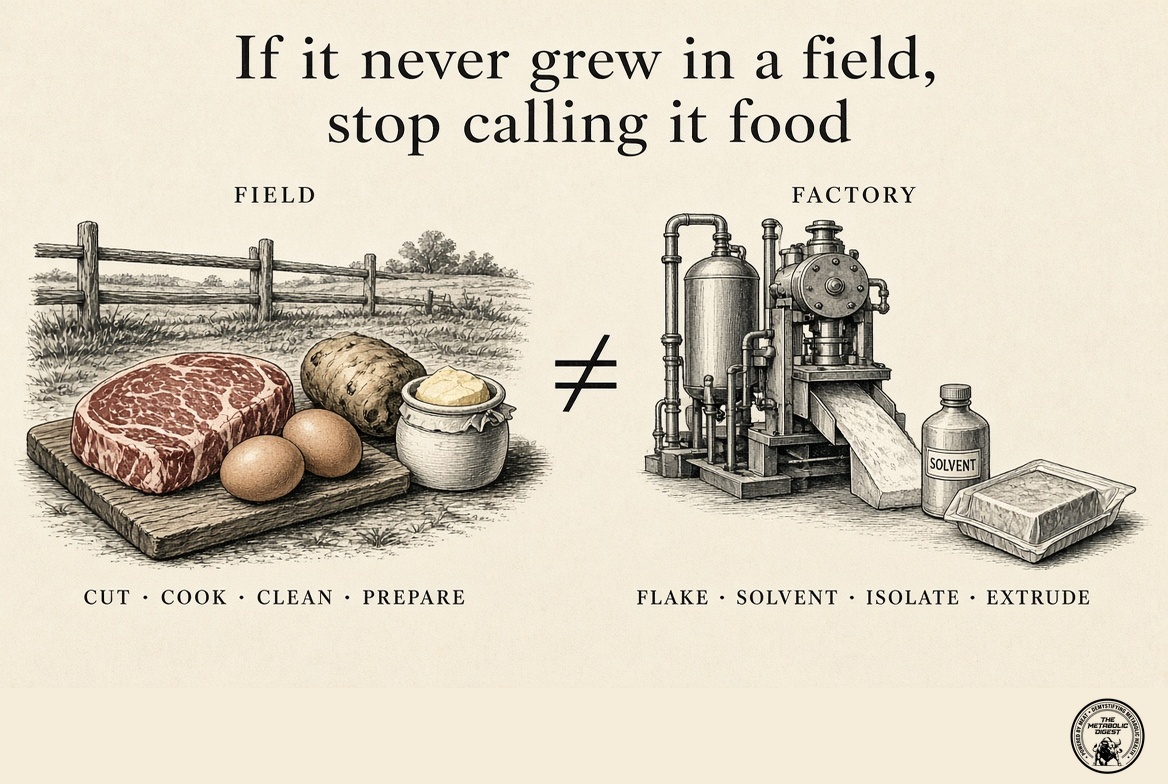
This site’s field-versus-factory test asks whether a kitchen, a farm, or a butcher could finish the food without a chemical plant. See If it never grew in a field, stop calling it food.
That is an editorial whole-food standard, not another name for NOVA. Industrially refined seed oils fail this site’s field test while remaining Group 2 processed culinary ingredients under NOVA. They are not something a kitchen can make.
What the feeding research actually shows
In Hall and colleagues’ 2019 controlled feeding trial, 20 adults lived at the NIH Clinical Center and spent two weeks on each of two diets. They could eat as much as they wanted. On the ultra-processed diet, they ate about 500 extra calories a day and gained weight. On the unprocessed diet, they lost weight.
The menus were matched for several nutrients as offered, not as eaten. The diets differed in several ways at once. The trial therefore cannot tell us which additive, texture, ingredient combination, or other feature caused the difference. It was also small, short, and not a test of addiction.
In DiFeliceantonio and colleagues’ 2018 laboratory study, people were willing to pay more for foods that combined fat and carbohydrate than for foods that supplied mainly one or the other, even when the foods were matched for calories and liking. That is evidence about reward value — not proof that every such mixture causes overeating.
Likewise, Fazzino and colleagues’ hyper-palatable food definition uses three nutrient combinations: fat with sugar, fat with sodium, or carbohydrate with sodium. NOVA uses processing. The two overlap, but they are not the same classification.
How to read your next label
- Read the ingredients before the front-of-pack claims.
- Identify the main food ingredients, then the separated or rebuilt ingredients.
- Sort the rest by job: sweetness, texture, preservation, color, or flavor.
- Distinguish ordinary kitchen ingredients from recognized NOVA markers.
- Check unfamiliar ingredients against a named source. Keep processing, nutrient content, and evidence of harm as separate questions.
The aim is informed choice — not fear of every long word, and not a free pass for a product because “keto” is printed on the box.
Do some thoughtful research. Your health, your responsibility.
The Metabolic Digest is an educational library about metabolic health and whole-food, animal-based ketogenic nutrition. Nothing on this site is medical advice, diagnosis, or treatment. Food, fasting, sleep, and training changes can affect medications, especially drugs that lower blood glucose. Individual responses vary. Consult a clinician who understands metabolic health before you change how you eat, train, fast, or read your labs. Your health is your responsibility.
Discuss on Instagram: @metabolic_digest
Continue exploring