
The salt advice turns on the system that holds salt

These articles are for information only. They are not medical advice, diagnosis, or treatment. Read the full disclaimer.
Medical Disclaimer. This information is for educational purposes only and is not medical advice, diagnosis, or treatment. Always consult a qualified healthcare professional before making changes to your diet, lifestyle, fasting practices, or medications. Do not stop or change any prescribed treatment without your doctor's guidance. Individual responses vary, and what works for one person may not be safe or effective for another.
Ben Bikman has two lectures that frame this page. In Salt and Cardiometabolic Health he walks the salt-holding system and insulin. In The Unexpected Link Between Salt Regulating Hormones and Metabolic Health he walks what those hormones do to insulin and fat cells. This page uses those lectures as the map, then the papers.
Bottom line first
Cutting salt turns on the system that holds salt. That system is the renin-angiotensin-aldosterone system, or RAAS. High insulin, the kind a high-carbohydrate pattern keeps up, also tells the kidney to hold sodium. Water follows sodium. A metabolically healthy person can clear extra salt. A person with high insulin tends to hold more of it. The blood-pressure drop from cutting salt is real, and it is small unless pressure is already high.
The holding system
The kidney watches pressure and sodium. If either looks low, it releases renin. The liver supplies angiotensinogen. Renin cuts angiotensinogen into angiotensin I. In the lungs, an enzyme called angiotensin-converting enzyme (ACE) turns angiotensin I into angiotensin II. Angiotensin II tightens vessels and tells the adrenal gland to make aldosterone. Aldosterone tells the kidney to keep sodium. Water stays with the sodium. Pressure rises, the trigger quiets, and the loop rests.
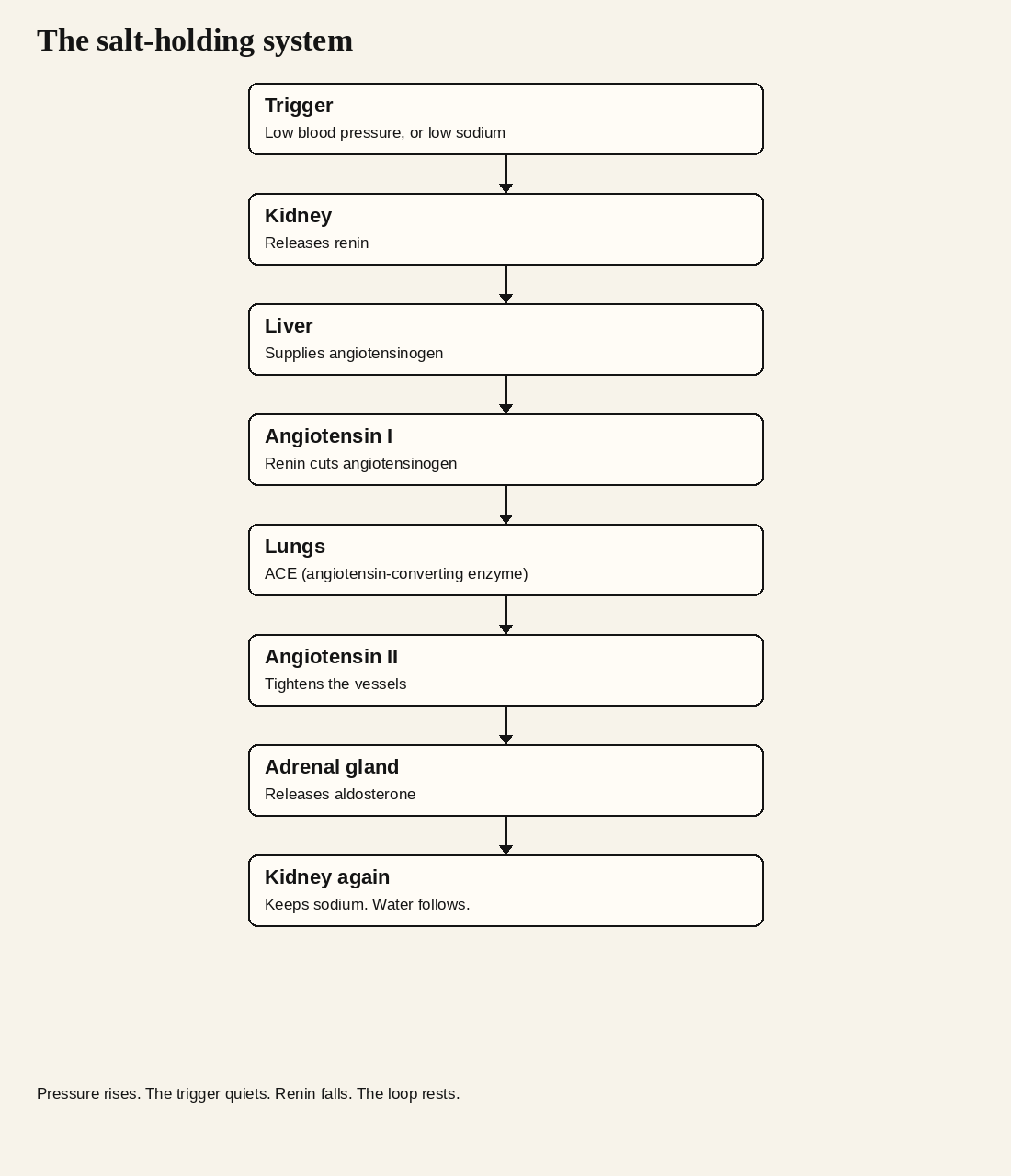
A low-salt diet is one of the signals that turns it on. A review of the salt-cut trials found that a low-sodium intake raises renin, aldosterone, and noradrenaline (Graudal et al., Cochrane, 2020). The body is doing what it was built to do. It is trying not to run out.
Who clears salt, and who holds it
In a metabolically healthy person, insulin is low between meals. The kidney can let extra sodium go. The holding system stays quiet unless pressure or sodium actually falls.
In a person with high insulin, the kidney gets a hold signal all day. Insulin tells the tubule to take sodium back. Salt that a healthy kidney would clear stays in the body. Water stays with it. That is one path from a high-carbohydrate pattern to higher pressure. See What is insulin resistance. [site]
The split shows up when someone starts a low-carbohydrate or ketogenic pattern. Insulin falls. The kidney, which had been holding sodium, starts to clear it. Water goes with the sodium. That, along with water released as stored glycogen is used up, is the early drop in the scale, and it is why the first days can feel flat: sodium and water left faster than the person replaced them. Until the body acclimates, that person needs a little more salt, not less. Once insulin is lower and the kidney has settled, the extra need eases. Acclimation is the point. It is not a permanent salt target.
What a hard cut does to insulin
The same cut can raise insulin and dull insulin’s effect. In one small study, eight people ate about 5,400 mg of sodium a day for a week, then about 1,700 mg for a week. Fasting insulin rose relative to glucose, roughly doubling. Insulin’s ability to open vessels fell (Feldman and Schmidt, American Journal of Hypertension, 1999). It is eight people and one week. It is a signal, not a verdict.
A review that collected 23 human trials showing harm reported that a low-salt stretch raised fasting insulin, worsened a glucose test, or reduced insulin sensitivity. The authors gathered trials that showed harm, so it is not a count of all trials (DiNicolantonio and O'Keefe, Journal of Metabolic Health, 2023). Not every trial agrees. One clamp study found a low-sodium diet lowered insulin secretion and left sensitivity unchanged (Luther et al., Journal of Clinical Endocrinology and Metabolism, 2014). The fair read is that a hard, short cut often pushes insulin the wrong way. It is not a law for every person.
High carbohydrate, high insulin, held sodium
Insulin tells the kidney to take sodium back. That is old, repeated work. A high-carbohydrate pattern keeps insulin up, so the holding signal stays on.
In seven healthy men, switching to a high-carbohydrate diet cut urinary sodium within two or three days. By the second week urinary sodium returned to baseline, and aldosterone fell. Blood pressure did not rise in that short window (Affarah et al., American Journal of Clinical Nutrition, 1986). So the carb-driven hold is real. The aldosterone rise is not automatic. In that study the body lowered aldosterone to offset the hold.
An acute insulin clamp in six men raised renin and angiotensin II, and aldosterone fell, in step with a drop in potassium (Trovati et al., Metabolism, 1989). Animal work does show insulin signaling can raise aldosterone. The human picture is mixed. What is solid is the direct hold: high insulin, less sodium in the urine, more sodium in the body. Water follows.
That is the loop Bikman is pointing at. A high-carb pattern keeps insulin up. Insulin holds sodium. If you then cut salt, RAAS turns on to hold what is left. You can end with higher insulin and a holding system that is wide awake.
What the pressure trials actually show
These trials changed salt on ordinary diets. They did not put people on a low-carbohydrate or ketogenic pattern. Cutting salt does lower pressure. The size depends on where you start. In a meta-regression of 133 trials, a sodium cut lowered systolic pressure by about 7.7 mm Hg per 100 mmol in groups already at the high end of pressure. In groups at or under 131/78, the drop was about 1.5 mm Hg (Graudal et al., American Journal of Clinical Nutrition, 2019). A longer, more modest cut, four weeks or more, lowered systolic pressure by about 4 mm Hg across the pooled trials (about 5 in people with high pressure, about 2.4 in people without) (He et al., Cochrane, 2013).
A couple of points in a person without high pressure is not the crisis the advice implies. In a person with high pressure, the drop is larger, and it still comes with higher renin and aldosterone. Salt is not innocent. It is also not the lever the slogan makes it.
What to do with this
This is not a salt target. A person on a blood-pressure drug, a water pill, or a new low-carbohydrate pattern will handle sodium differently. Those drugs and that pattern both change how much sodium the kidney keeps. Do not stop a drug because of this page.
If pressure is high, the more useful question is what is keeping insulin up, not only how many milligrams of sodium are on the plate. A lower-carbohydrate pattern often drops insulin, and the kidney then lets more sodium and water go. In the first days, replace what is leaving. After that, the need settles. It is not a promise, and it is not one size. Acclimation matters. So does the drug list.
Do some thoughtful research. Your health, your responsibility.
Postscript
Ben Bikman. Salt and Cardiometabolic Health (May 2024). Salt-regulating hormones (December 2024).
Feldman and Schmidt, moderate salt restriction and insulin resistance (American Journal of Hypertension, 1999). DiNicolantonio et al., 23 trials (Journal of Metabolic Health, 2023). Luther et al., low sodium and insulin secretion (Journal of Clinical Endocrinology and Metabolism, 2014). Affarah et al., high-carbohydrate feeding and sodium (American Journal of Clinical Nutrition, 1986). Trovati et al., insulin and RAAS (Metabolism, 1989). Graudal et al., low versus high sodium, hormones and pressure (Cochrane, 2020). Graudal et al., dose-response of sodium and pressure (American Journal of Clinical Nutrition, 2019). He et al., modest salt reduction (Cochrane, 2013).
Also discussed on X and Instagram: @metabolicdigest and @metabolic_digest.
Medical Disclaimer. This information is for educational purposes only and is not medical advice, diagnosis, or treatment. Always consult a qualified healthcare professional before making changes to your diet, lifestyle, fasting practices, or medications. Do not stop or change any prescribed treatment without your doctor's guidance. Individual responses vary, and what works for one person may not be safe or effective for another.
This article is for informational purposes only. Full disclaimer: /disclaimer
Your health, your responsibility.
Continue exploring
Related reading.
Insulin & Hormones